RESIDENTIAL PROJECT
LOXONE HOME AUTOMATION | MUAR, JOHOR

A contemporary three level residence in Muar, Johor, designed by Bizcus Design and automated by Madoc on Loxone. Lighting, shading, climate, audio, networking, cameras and security are handled by one system inside the building, with conventional manual control deliberately retained throughout so the house still works on the day the automation does not.

LOCATION

Muar, Johor, Malaysia

DESIGN

Bizcus Design

AUTOMATION

Loxone and KNX, engineered and installed by Madoc

SYSTEMS

Lighting, shading, climate, audio, networking, cameras, security

MEDIA

Featured by Tatler Asia

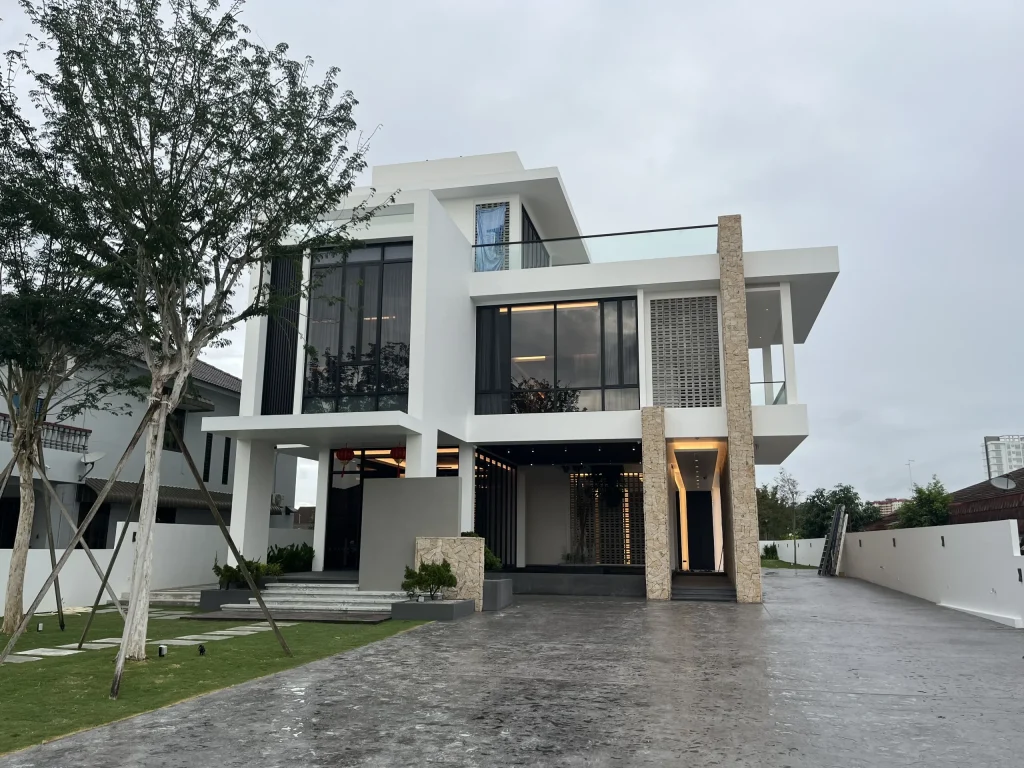
Muar Residence facade and covered carport at dusk, with concealed cove lighting under the upper floor.
THE HOME

Architecture Designed Around Climate and Daily Life

Tatler Asia describes the residence as approximately 19,000 square feet across three levels, designed by Bizcus Design for a household of three. The design draws on principles associated with the traditional Malay stilt house. Elevated living spaces, wind induction channels and water features move air through the building, and a raised floor plan reduces the reliance on mechanical cooling.

The architecture, in other words, does a great deal of the environmental work before any technology is involved. That shaped how we approached the automation. The brief was never to make the house clever. It was to keep a very large building easy to live in.

Architecture and interior design: Bizcus Design.

THE ENGINEERING QUESTION

A Large Home Should Not Become a Large Management Problem

A substantial home occupied by a small household creates a specific engineering question. Every additional room, circuit, blind, air conditioning unit and speaker is one more thing that could ask for attention. Multiply that across three levels and a house can end up managing the people in it rather than the other way round.

This is where automation earns its place. Routine decisions are handled by the system, so the size of the house does not translate into a larger daily workload for the household. Where a decision genuinely belongs to the occupants, a control is within reach. That balance is the same principle we set out in our article on what makes a home truly smart: the technology should ask less of the people living with it, not more.

SYSTEM ARCHITECTURE

One Controller, Two Wiring Standards

The system is built around a Loxone Miniserver, which holds the automation logic for the whole house. A Loxone KNX Extension connects that Miniserver to a KNX line, so the installation runs on two buses at once: Loxone Tree for room level devices, and KNX for the switching hardware inside the electrical panels.

That combination was deliberate rather than incidental. Tree keeps sensor and interface wiring simple and quick to commission. KNX gives access to industrial grade actuators that carry physical controls on the device itself, which matters a great deal for the reason set out below. More on the platform is on our Loxone Malaysia page.

LOXONE MINISERVER

Central automation logic for the whole house, processed on site.

LOXONE KNX EXTENSION

Bridges the Miniserver to the KNX line serving the electrical panels.

LOXONE TREE

Room level bus for sensors, interfaces and lighting devices.

KNX RELAY ACTUATORS

Eelectron 16 channel actuators switch the lighting circuits, with manual control on the device.

KNX INPUT MODULES

Eelectron 4 channel modules bring conventional pushbuttons into the same system.

LOXONE RELAY EXTENSION

Switching for the motorised shading, under the same logic as the lighting.

LOXONE RGBW TREE

Dimmable colour and white LED strip lighting in the cove and joinery details.

AUDIOSERVER AND STEREO EXTENSION

Multi room audio, amplified centrally into Quadral passive speakers.

NETWORK, CAMERAS AND SECURITY

Ubiquiti networking, Hikvision cameras and Loxone security logic.

LIGHTING

Lighting That Still Works on the Day the System Does Not

One of the clearest requirements from the client had nothing to do with scenes or apps. It was about what happens if the automation is unavailable. In a house of this size, lighting that can only be operated through a controller is a risk rather than a feature.

The lighting circuits are therefore switched by Eelectron 16 channel KNX relay actuators mounted in the electrical panels. Every channel on those actuators can be operated by hand at the device. If the controller is taken out of service for maintenance, or a fault is being traced, an electrician can restore any circuit in the house at the panel without depending on the automation at all. Nothing in the lighting design requires software to be healthy for the lights to come on.

That single requirement shaped the installation. It is the reason KNX was brought in alongside Loxone Tree instead of running the whole house on one bus.

Dry kitchen and dining area at Muar Residence, with timber joinery and track lighting.
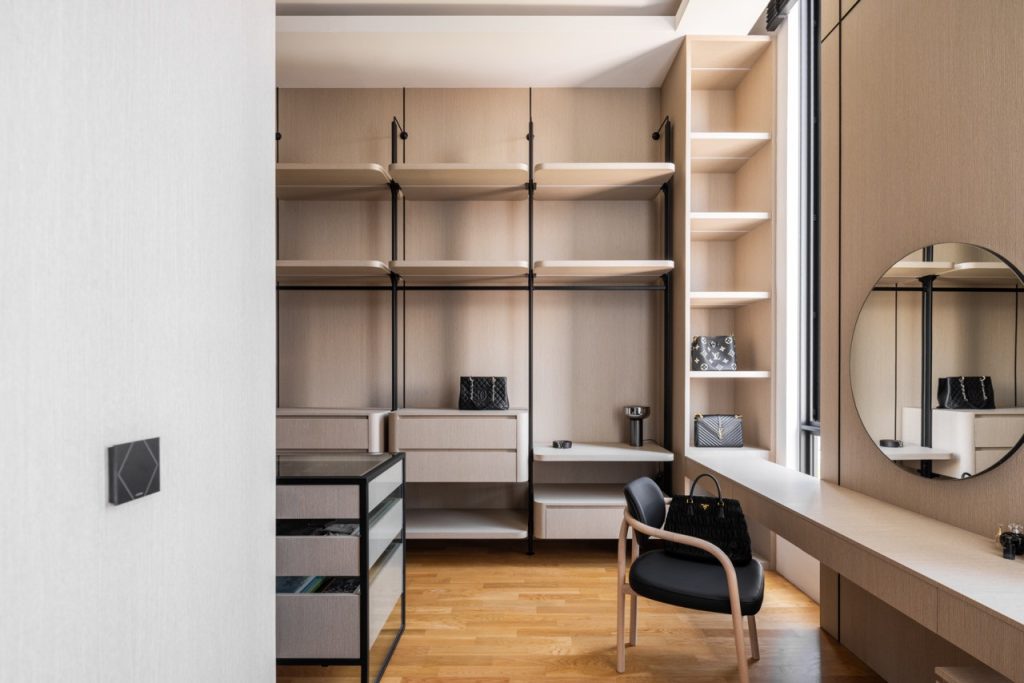
Loxone Touch Pure in Anthracite mounted at the entrance to the dressing room of Muar Residence.
PHYSICAL CONTROL

Touch Where It Belongs, Pushbuttons Where It Does Not

Loxone Touch Pure in Anthracite is used through the main living areas and bedrooms. It reads as a single flush plate rather than a bank of switches, and one touch surface carries several functions, so a room can be controlled without a wall of gang plates competing with the joinery.

Not every room deserves that. Toilets, bathrooms and store rooms use conventional pushbuttons wired back to Eelectron 4 channel KNX input modules. They behave exactly as anyone expects a switch to behave, they suit wet hands and guests who have never seen the house before, and they cost a fraction of a touch interface. Because they report into the same system, those circuits can still be included in automation logic wherever that is useful.

Deciding where a touch interface earns its place, and where an ordinary switch is simply the better answer, is most of the design work in an installation like this.

LIGHT, SHADE AND SOUND

The Systems That Move on Their Own

Bar and lounge area at Muar Residence, with floor to ceiling curtains and concealed cove lighting.
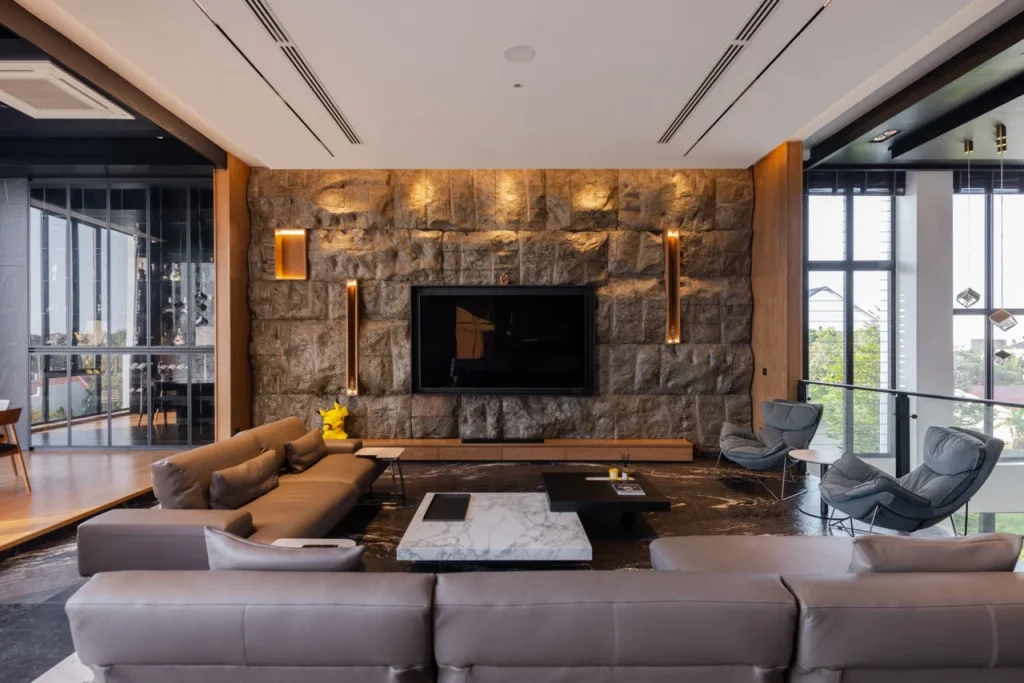
Living room television wall at Muar Residence, lit by concealed grazing light across natural stone.
PRESENCE DETECTION

Loxone Presence Sensor Tree units bring occupancy into the lighting logic, so circulation and service areas do not depend on anyone remembering a switch.

COLOUR AND WHITE LED

Loxone RGBW Tree dimmers drive the LED strip in the cove and joinery details. Because the strip is dimmable and colour capable, one architectural detail can carry a bright working light and a low evening level.

MOTORISED SHADING

Shading is switched through a Loxone Relay Extension, so blinds and curtains sit inside the same logic as the lighting rather than living on a separate remote control.

MULTI ROOM AUDIO

Audio runs on a Loxone AudioServer with a Stereo Extension, feeding Quadral passive speakers. Amplification is centralised, so the rooms carry speakers and nothing else.

NETWORK, CAMERAS AND SECURITY

The Infrastructure Everything Else Depends On

All of the above needs a network that does not fail quietly. The residence is served by Ubiquiti networking, specified and configured as part of the project rather than left to whatever equipment the internet provider supplied. Hikvision cameras cover the approach and perimeter, and the Loxone system carries the security logic, so alarm states, presence and lighting are able to inform each other instead of running as three unrelated products.

Bringing these under one project has a practical consequence. When something is wrong, there is one place to look and one party responsible for it.

Guest house living area at Muar Residence, opening onto the terrace through full height sliding glazing.
LOCAL AUTOMATION

The Logic Runs Inside the Building

Core automation logic in a Loxone system is processed locally on the Miniserver inside the house. Configured functions such as lighting, climate and security logic do not depend on a cloud connection to carry out their local automation, and project data is processed on site rather than routed through external servers. Internet connectivity is still used for the services that need it, such as remote access from outside the home.

For a private residence that is not a technical footnote. It determines how the house behaves during an internet outage, and where information about daily life in the building actually lives. Our article on wired against wireless smart homes in Malaysia explains how we make these architecture decisions.

PROJECT PHOTOGRAPHY

The Building and the Automation Should Support Each Other

This residence was designed to manage heat, light and airflow through architecture first. The automation does not compensate for the building. It responds to it, adjusting the systems the architecture cannot move on its own.

That is the relationship we look for in every project. The building does what buildings do well, the automation handles what changes minute by minute, and neither becomes the visual centrepiece of the home.

Main living room at Muar Residence, with a stone feature wall, flush ceiling speakers and linear air conditioning diffusers.
Front elevation of Muar Residence, a contemporary three level home in Muar, Johor.
FEATURED IN TATLER ASIA

A Contemporary Muar Home Built Around Stillness and Vernacular Restraint

TATLER ASIA

Tatler Asia featured the residence in its Homes section in February 2026 and identified the home’s Loxone system as installed in partnership with Madoc Integration Solution, managing lighting, climate control and security from a single local platform.

READ THE TATLER FEATURE
EXPERIENCE LOXONE IN MUAR

See a Working Loxone System Nearby

For clients in southern Malaysia who want to experience a working Loxone system before committing to one, the Muar partner showroom is available by appointment in collaboration with Zense Integrated Systems. The showroom itself was designed by Bizcus Design.

BOOK AN APPOINTMENT

Discuss Your Home Automation Project

If you are planning a home in Johor or elsewhere in Malaysia, Madoc can help you decide which building functions deserve permanent infrastructure, where automation genuinely improves daily life, and where a conventional switch is still the right answer. You can also read more about how we design and integrate building systems.

VIEW RESIDENTIAL PROJECTSBOOK A CONSULTATION

Leave a Reply