
KNX comes up in Malaysian projects in two very different ways. Sometimes an architect or consultant specifies it early, because the building is large and the electrical design is already complex. More often it appears late, when somebody realises that a house full of individual smart products is not going to behave like one system.
KNX is not a brand and it is not a product you buy in a box. It is an open standard for building control, and understanding what that actually means is the difference between specifying it well and specifying it because it sounded serious.
This article explains what KNX is, where it genuinely earns its place in a Malaysian project, how it works alongside Loxone and DALI-2, and the situations where a project does not need it at all.
KNX is an open, wired standard for building control. Devices from different manufacturers share one bus and are programmed to work together, so the system is not tied to a single supplier. It suits larger buildings and homes with many circuits and a long expected service life. It is not a consumer product, and it needs proper design and commissioning to be worth the money.
What KNX actually is
KNX is a standard, not a manufacturer. It defines how control devices talk to each other over a shared bus, and it is maintained independently of any one company. That single fact is the reason it exists and the reason it behaves differently to most things sold as smart home technology.
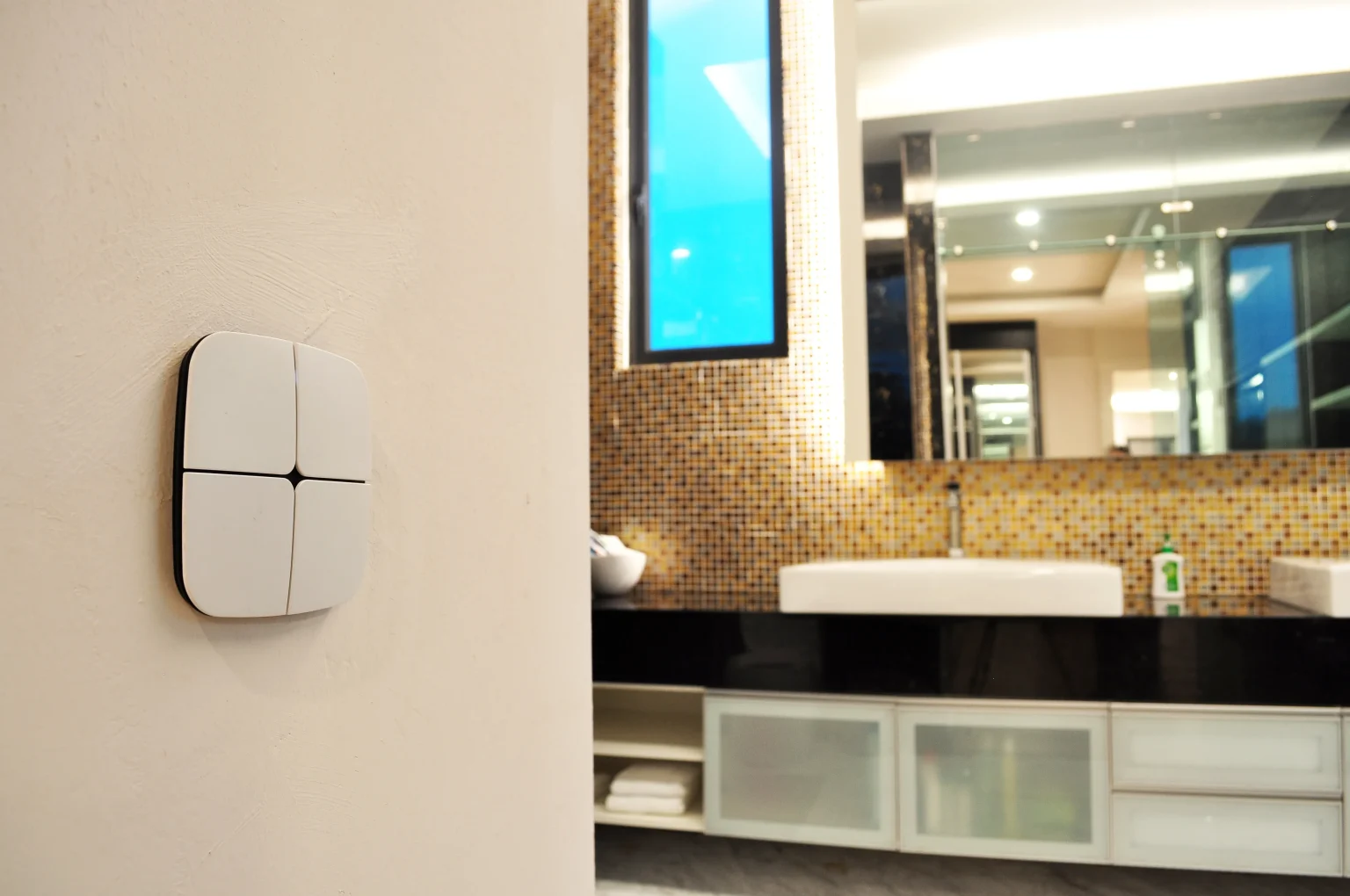
In practice a KNX installation is a two-wire bus running alongside the mains wiring, connecting devices such as wall pushbuttons, sensors, actuators in the distribution board, thermostats and interfaces. Each device is a small independent computer. It is given an address and a role during commissioning, and it holds that programming itself.
There is no central box that everything depends on. If one device fails, the rest of the bus keeps working. This distributed arrangement is the architectural difference that matters most, and it is why KNX turns up in buildings that need to keep running for decades rather than product cycles.
Why KNX exists at all
KNX came out of a problem the European electrical industry had in the 1990s. Manufacturers were each building their own incompatible control systems, which meant a building owner was locked to whoever installed the first one. Replacing a failed component years later could mean replacing an entire system.
The response was to agree on a common protocol so that devices from different manufacturers could share the same bus. A dimmer from one company can sit alongside a sensor from another and a pushbutton from a third, and they can be commissioned to work as one system.
For a building owner this is a practical protection rather than an abstraction. It means the system can be maintained, extended and repaired without being hostage to one supplier's commercial decisions.
How KNX differs from consumer wireless systems
Most products sold as smart home devices are designed for a different job. They are made to be bought individually, installed by the owner, and replaced when something better appears. That is a reasonable design goal, and for a lamp or a plug it works well.
KNX assumes the opposite. It assumes the control layer is part of the building, installed once during construction, and expected to work every day for many years without attention. Everything about it follows from that assumption: wired connections rather than radio, local programming rather than cloud accounts, and a commissioning process carried out by someone trained to do it.
Neither approach is universally correct. We have written separately about where wired and wireless each make sense in a Malaysian home, and the honest answer is that most good projects use both. The mistake is expecting consumer products to behave like building infrastructure.
How a KNX system is put together
You do not need to program KNX to specify it sensibly, but it helps to understand the shape of it.
The bus cable runs from the distribution board to every device that needs to participate. Devices that switch or dim circuits usually live in the board itself, so the load wiring stays where an electrician expects to find it. Devices that people touch, such as pushbuttons and room controllers, sit on the wall and carry only the bus cable, not mains switching.
Sensors report conditions. Actuators act on circuits. Interfaces connect the bus to other systems. Commissioning is the step where each device is told what it is, what it responds to and what it controls.
Because the intelligence is distributed, a KNX system does not stop when a controller stops. That is a genuine reliability advantage in a large building, and it is worth weighing against the fact that distributed programming takes longer to design and document.
Where Madoc uses KNX
We do not specify KNX by default. We specify it where the building's requirements point to it, and three of our projects show the different reasons that happens.
Templer Heights was Madoc's first project, a five-storey private villa in Rawang, Selangor. It was planned around KNX from the beginning, with lighting, ceiling fans and air conditioning controlled through the system. The system was designed, programmed and commissioned by Madoc.
Muar Residence is a contemporary three-level home in Johor where automation runs on Loxone and KNX together, covering lighting, shading, climate, audio, networking, cameras and security. Manual control was deliberately retained throughout, so the house still works on a day the automation does not.
TNB Hub Iskandar Puteri applies the same combination to a commercial building, coordinating power monitoring, air conditioning, scheduling and environmental monitoring so routine building functions run without staff operating equipment through the day.
Not every Madoc project uses KNX. Country Heights Damansara, for example, did not need it. That is the point: the standard is a tool, not a badge.
KNX and Loxone in the same system
This is the question we are asked most often, and it is usually framed as a competition. It is not one.
Templer Heights is the clearest illustration because it happened to us in sequence. The villa was already planned and installed around KNX for lighting, ceiling fans and air conditioning. As the project neared completion we began working with Loxone, and we integrated a Loxone Miniserver with the existing KNX installation.
What that changed was not the wiring or the field devices. Those continued to do exactly what they were installed to do. What it added was a layer of logic on top: the ability to build behaviour across systems rather than control each one separately.
That is generally the useful division. KNX is strong as a robust, open, distributed field layer, particularly for lighting and climate in a large building. Loxone is strong as an automation and logic layer that ties systems together and gives the household a coherent way to interact with them. Used together they cover more ground than either does alone.
Anyone presenting this as a choice between two rivals is usually selling one of them. You can read more about how Madoc uses Loxone as the automation core of most of our projects.
KNX and DALI-2
DALI-2 solves a narrower problem than KNX. It addresses individual light fittings over a two-wire bus, rather than switching or dimming whole circuits, which makes it useful where there are many fittings or where groups need to be reorganised later without rewiring.
KNX and DALI-2 are complementary rather than alternative. A common arrangement is DALI-2 handling the lighting layer, with a gateway presenting it to KNX so lighting participates in the wider building logic alongside climate, shading and presence.
We use DALI-2 where the lighting design justifies it. On a project with a modest number of circuits it adds cost and commissioning time for little practical gain, and relay or phase-cut dimming on a KNX actuator is the better answer.
When KNX makes sense
KNX earns its place when several of these are true at once.
The building is large or complex. Many circuits, several floors, multiple distribution boards. This is where a distributed, addressable system starts to pay for itself.
The system is expected to last. If the owner intends to keep the building for decades, an open standard protects them from a single supplier withdrawing a product line.
Lighting and climate are the core requirement. These are the functions KNX handles most maturely, with the widest choice of devices.
The project is still at design stage. KNX is wired infrastructure. Deciding on it before first fix costs planning time. Deciding afterwards costs conduit and ceilings.
Multiple manufacturers are involved. If different trades are supplying different parts of the control layer, a common standard is what makes them one system.
When a project does not need KNX
Being straightforward about this matters more than promoting the technology.
A completed home that cannot be rewired is usually not a KNX project. Retrofitting a bus into finished plaster is disruptive and expensive, and the result rarely justifies it.
A modest apartment or condominium with a small number of circuits does not need it either. The engineering overhead outweighs the benefit, and a well designed system on another platform will serve the household better for less.
A project where the owner mainly wants app control of a few devices is not a KNX project at all. That requirement is met by simpler products, and specifying KNX for it wastes money.
Finally, a project with no appetite for a proper commissioning process should not use KNX. A poorly commissioned KNX system is worse than a competent conventional installation, because the complexity is still there and nobody has made it useful.
Why design and commissioning decide the outcome
KNX hardware is broadly reliable. The variable in any KNX project is the engineering around it.
Commissioning is where devices are given their addresses, their functions and their relationships. It is also where the system is documented, and documentation is what determines whether anyone can work on the building in five years. A system nobody can read is a system nobody can maintain.
This is the part that is invisible when comparing quotations. Two proposals can list similar hardware and produce completely different buildings. What separates them is how carefully the circuit schedule was thought through, how the logic was structured, and whether the person commissioning it understood how the household actually intends to live there.
It is also why we ask to be involved before the electrical drawings are finalised. Most of the decisions that determine whether a KNX system will be good are made on paper, months before anyone switches it on.
Working with an existing KNX installation
Buildings in Malaysia that already have KNX are usually in one of two situations. Either the system works but does less than the owner expected, or the original integrator is no longer available and nobody can modify it.
Both are workable, and neither necessarily requires replacement. Because KNX is an open standard, another competent integrator can take over an existing installation. What determines how difficult that is comes down to documentation. A well documented project can be picked up in days. An undocumented one has to be surveyed and reconstructed before anything can be changed safely.
Templer Heights is our own example of extending rather than replacing. Adding a Loxone Miniserver to a working KNX installation gave the project broader automation without discarding what was already commissioned and running.
The Malaysian construction context
Two things about building here affect this decision more than they would in Europe.
Construction is predominantly reinforced concrete and masonry, which is unhelpful for radio and helpful for anyone arguing to run cable while walls are open. If a decision about permanent control infrastructure is going to be made, it needs to be made during the shell stage.
Large homes are also common in a way that changes the economics. A substantial bungalow can carry a circuit count that pushes past what consumer systems handle comfortably, and at that scale the case for addressable, documented infrastructure becomes practical rather than theoretical.
Frequently asked questions
Is KNX better than Loxone?
They do different jobs. KNX is an open field-level standard, strongest as a robust distributed layer for lighting and climate. Loxone is an automation platform, strongest at logic and at tying systems together. Madoc uses them together on several projects, including Muar Residence and TNB Hub Iskandar Puteri.
Can KNX be installed in a completed house?
Usually not sensibly. KNX needs a bus cable to every participating device, and retrofitting that into finished ceilings and walls is disruptive and costly. For an existing home, other approaches are normally more appropriate.
Does KNX need an internet connection?
No. A KNX installation operates entirely on its own bus. Internet access is only needed for remote access and notifications, not for the building to function.
Can KNX devices from different manufacturers work together?
Yes. That is the purpose of the standard. Certified devices from different manufacturers share the same bus and are commissioned to work as one system, which is what protects the owner from supplier lock-in.
What happens if a KNX device fails?
Because the intelligence is distributed rather than central, the rest of the system continues to operate. The failed device is replaced and reprogrammed with its stored configuration, which is one reason documentation matters.
Can an existing KNX system be taken over by another integrator?
Yes, because KNX is an open standard. How straightforward it is depends almost entirely on how well the original installation was documented.
Is KNX suitable for commercial buildings?
Yes, and that is much of its origin. Madoc uses KNX alongside Loxone at TNB Hub Iskandar Puteri for power monitoring, air conditioning and scheduling.
KNX is worth specifying when a building is large enough, permanent enough and complex enough to justify wired, open, documented infrastructure. It is not a status symbol and it is not a shortcut. On the right project it is the most durable foundation available, and on the wrong one it is an expensive way to do something simpler.
Founder & Principal Integrator, Madoc
Muzamil Mahmud is the Founder and Principal Integrator of Madoc and has worked in building automation since 2013. His earlier training in avionics and aircraft engineering shaped Madoc's approach to reliability, maintainability and automation that reduces unnecessary interaction. He remains directly involved in system architecture, integration strategy, programming direction and commissioning across Madoc's residential and commercial projects.
ProjectTempler Heights: KNX and Loxone in a five-storey villa→Decide the Control Infrastructure Before First Fix
If your project is still at architectural, electrical or interior-design stage, this is the point at which KNX, Loxone and DALI-2 can be assessed properly against what the building actually needs. Madoc designs, programmes and commissions these systems across Malaysia.
Book a Consultation Our Services